Intro

I love movies. I have loved movies all my life. I grew up on them. When I was eight years old, I managed to convince myself I would make movies when I grew up. Now I am in the process of getting a degree in Film Studies. I write about film more than ever before, partly because I have to for my classes, mostly because I enjoy it, because I have something to write about. Sometimes it helps me understand the film better; sometimes it helps me understand myself better.
I created this blog as a place to showcase my work, and also as an incentive to keep writing reviews, analyses, and essays over breaks, when there’s no one here to grade me.
I have tried many times, and failed, to explain in a coherent manner why it is that I love films. Here is my best—and most coherent—guess.


Showing posts with label Cinematography. Show all posts

Wednesday, March 18, 2015

Bazin and Cinematic Realism(s)


“The faithful reproduction of reality is not art. We are constantly told that it consists in selection and interpretation….That it why up to now the ‘realist’ trends in cinema, as in other arts, consisted simply in introducing a greater measure of reality into the work: but this additional measure of reality was still only an effective way of serving an abstract purpose, whether dramatic, moral, or ideological…. Realism subordinates what it borrows from reality to its transcendent needs. Neorealism knows only immanence. It is from appearance only, the simple appearance of beings and of the world, that it knows how to deduce the ideas that it unearths. It is a phenomenology”
– Andre Bazin, “Vittorio De Sica: Metteur en Scene” (64-65)


In “The Ontology of the Photographic Image,” Andre Bazin points out the indexical nature of the cinema, the objective character of photography which provides it with a quality of credibility absent in the other arts. We are forced to accept the reality of the object presented, or “re-presented,” by the camera because the image it creates, like a fingerprint of reality, “shares, by virtue of the process of its becoming, the being of the model of which it is the reproduction; it is the model” (13-14, emphasis in original). Bazin’s essay ends, however, on a note that seems to contradict most of what has come before: “On the other hand, of course, cinema is also a language.” If we are to understand that film is not only indexical, but, like language, then, also symbolic, constructed through an arbitrary connection to the object represented, how can we speak of cinematic realism,  “an integral realism, a recreation of the world in its own image” (“The Myth of Total Cinema” 20)? In order to answer that question, we must first distinguish between the different types of realism that Bazin discusses.

Thursday, July 10, 2014

Only Lovers Left Alive (2013)


Tilda Swinton and Tom Hiddleston make the perfect pair of ivory-skinned wraiths in maverick moviemaker Jim Jarmusch’s Only Lovers Left Alive. These fabulously aloof, effortlessly stylish creatures are the coolest people you could imagine. They were hipsters before it was cool to be a hipster—a few centuries before, actually.  In the film’s hypnotic opening sequence a spinning 45-rpm record fills the screen, and Wanda Jackson’s witchy, bewitching wail fills your soul. The image dissolves into a revolving bird’s eye view of two silent, still figures, she surrounded by countless stacks of books strewn across the floor, he reclined in a couch amid vintage guitars and vinyl records, miles apart yet seemingly in the same room. Round and round they go, the camera circling closer and closer, inviting you to follow down the rabbit hole of this dark, delirious, delicious film. These bloodsuckers might be after your hemoglobin, but their story and style will start seeping into your veins as early as that first shot. Jarmusch’s undead really know how to live.


Friday, June 6, 2014

The Immigrant (2013)


A great classicist, James Gray has often been called painterly, operatic, novelistic. It’s as if we have forgotten what good cinema looks like, searching other media for a comparison, assuming the heft and heart of art and literature is somehow outside the movies’ grasp. Gray’s The Immigrant, which premiered last year at Cannes and is just now hitting theaters, is a romantic tale that hides its monumental scale and subject in plain sight, a subtle, soulful masterpiece that cuts to the very heart of the American experience. Wrapping big themes in an intimate embrace, the film feels both epic and personal. It not only reminds us of what film used to be, but also of what it could be once again. A story of survival and redemption for the characters, the movie surely accomplishes the same for a very specific, straightforward kind of filmmaking that I haven’t seen in a very long time.

A mournful, mesmerizing meditation on the immigrant experience, the movie opens on a slow zoom of the Statue of Liberty shrouded in foggy mist, its back turned to the camera. From that first moment, The Immigrant unfolds in the foggy, misty gap between the promise the statue embodies and the harsh realities newcomers encounter when that promise turns its back on them. Later in the film, Lady Liberty will make a second appearance, this time as the main character’s cabaret costume, a sad parody of the ideals represented by the statue. The woman is asked why she came to America. “I want to be happy,” she mouths gently, her voice breaking with infinite sorrow. In another show, a magician levitates before the Ellis Island detainees, who are for the most part awaiting deportation to their home lands, assuring them that anything is possible if they believe—“The American Dream is waiting for you,” he says at the end of the act. How appropriate that the pep talk comes in the middle of a con act.

Wednesday, May 21, 2014

Nebraska (2013): One for the Money, Two for the Road


After making side trips to California’s Central Coast and Hawaii for Sideways (2004) and The Descendants (2011), Alexander Payne takes to the road yet again, this time in his home state, for Nebraska (2013), a wistful ode to small-town Midwestern life and the quixotic dreams of stubborn old men. Payne’s prairie-based old-age odyssey begins, appropriately, on a busy stretch of highway. 

A small, solitary figure shuffles along the side of the snow-fringed road, stooped and scowling in the wind. His determined trudging is interrupted by a police officer, who asks where he’s coming from and where he’s headed. Wordlessly, the old man points back and then forward. This is a man who, like his surroundings, seems to have outlived his usefulness; he has that self-involvement the way someone does when he’s staring death in the face, bobbing and weaving along that highway to avoid his inevitable mortality. His journey is a last, valedictory gesture designed to give meaning to a life. He seems confused, but there’s a heartbreaking purity, a blankness to him, as well as a hunger and a ferocity, that feel terrifyingly real. Without saying a word, he has hit upon a deep and eloquent truth: like the character, that’s all we really know in life—that we came from back there and we’re going forward on the road, regardless of where it might lead, because we have no idea what the end destination is or where we’ll end up anyway. 

NEW: PAYNE'S About Schmidt, Sideways, The Descendants Analysis HERE


In surprising ways, his odyssey resembles those of Dave Eggers’ You Shall Know Our Velocity, DBC Pierre’s Vernon God Little, Richard Linklater’s Before Sunrise (1995) and Walter Salles’ Motorcycle Diaries (2004). The protagonists of these works are all younger than Payne’s character; they have had different life experiences; they travel different lands. But, through each of their journeys, they seek the same meaningfulness, defining their own identities in relation to others and to their environments, looking for a place they belong, and trying to establish a human connection.


Thursday, January 16, 2014

2014 Oscar Nominations – This Year It's All About Who's Not There


Well, the Academy of Motion Picture Arts and Sciences voters—i.e. the people who hand out those tiny little golden men everyone seems to be talking about today—have had their say. Here is my response.


Monday, January 6, 2014

Inside Llewyn Davis (2013)


Subtle and surreptitiously soulful, Joel and Ethan Coen’s latest has a light, tender touch and a surfeit of sincere, deep feeling, two things the Coen brothers generally lack. A lot of the emotion comes from the music itself, supervised by T. Bone Burnett, a man who really knows his way around a ballad. The film is as melancholy as the somber, smoky, sweet songs filled with steely, blue notes, providing a startlingly straight-faced departure for the directing/writing/producing/editing duo behind Fargo, No Country for Old Men, The Big Lebowski, Burn After Reading, and Raising Arizona. Marvelous and mordantly funny, Inside Llewyn Davis is deeply personal, boldly original, and highly emotional.

The sounds of the early sixties folk music revival float in the air like a strange, intoxicating perfume, reflecting the lonesomeness and romance of the traveling life, particularly the meandering, fraught journey of a guitar-strumming balladeer trying to reconcile his life and his art. Oscar Isaac, who portrays the title character with sincere conviction and a haunting humanism, can definitely sing, in a fine, clear tenor voice that palpitates with the poignant pain of loss, longing, and loneliness. All of the songs speak to this pain and to the rootlessness and regret of his existence: “Fare Thee Well,” “Five Hundred Miles (Away From Home),” and especially “Hang Me, Oh Hang Me,” which opens the film: “wouldn’t mind the hangin’ except for layin’ in the grave so long, poor boy... I been all around this world.” The words and chords don’t just enrich the movie, they complete it, tapping into reservoirs of otherwise inaccessible feelings.

Thursday, December 5, 2013

Oldboy (2013)


I feel I must preface this review by admitting, unfortunately, that I have not seen the reportedly brilliant, shockingly successful source material for Spike Lee’s Oldboy, Park Chun-wook’s 2003 Korean cult classic described by one critic as “adapted from a manga comic-book, which was in turn adapted from an overwhelming desire to see what damage hammers do to foreheads.” As I have been deprived of this undoubtedly awesome experience (while most critics have not), I will refrain from making any comparisons between Lee’s movie and its inspiration (which most critics have made). It is my understanding that the new and unimproved Oldboy falls sadly short of its predecessor, but, for those of us who haven’t seen the Korean version, this reimagining can still be a lot of fun.


Although the negative reviews have probably managed to kill Lee’s film by now, Oldboy is a movie worth resuscitating. With its big name actors, celebrity director, and commercial genre qualities, the movie is not a masterpiece by any stretch, but it is a lively entry into Lee’s ongoing campaign to push into the mainstream (25th Hour, Inside Man). The film has an obsessive, hypnotic quality that could only be dampened by comparisons to the original. Even rarer, it’s an adult movie at a time when PG-13 films fill the multiplexes, a Nicolas Winding Refn for the masses.

Wednesday, November 27, 2013

Fargo (1996) Analysis


Joel and Ethan Coen’s Fargo opens, appropriately, in Fargo, North Dakota, although this is the only scene in the movie to actually take place in the title location. Over the opening credits we see a car, barely visible through the fog in the distance as it makes its slow progression through the snowy, bluish gray landscape. The tan Sierra goes up and down on the frozen-over roads, occasionally disappearing into snowy voids. The Coens’ Midwest is bleak and ominous, a mood perfectly underlined by Carter Burwell’s gloomy score. The brothers and virtuoso director of photography and long-time collaborator Roger Deakins create an epic landscape of near mythical proportions, if only for the purpose of contrasting it with the ordinariness and decidedly unheroic nature of the characters that inhabit it. Contradictions like this one abound in the Coens’ universe; their work has always defied definition. They play fast and loose in terms of plot and refuse to be constrained by the formal imperatives of conventional narrative, stitching together a number of different genres and in the end transcending such conventions altogether. Fargo starts out as a perfect-crime drama, but soon embraces conventions of the noir, the thriller, and tragedy, all with a big, darkly humorous smile on its lips.

Thursday, October 3, 2013

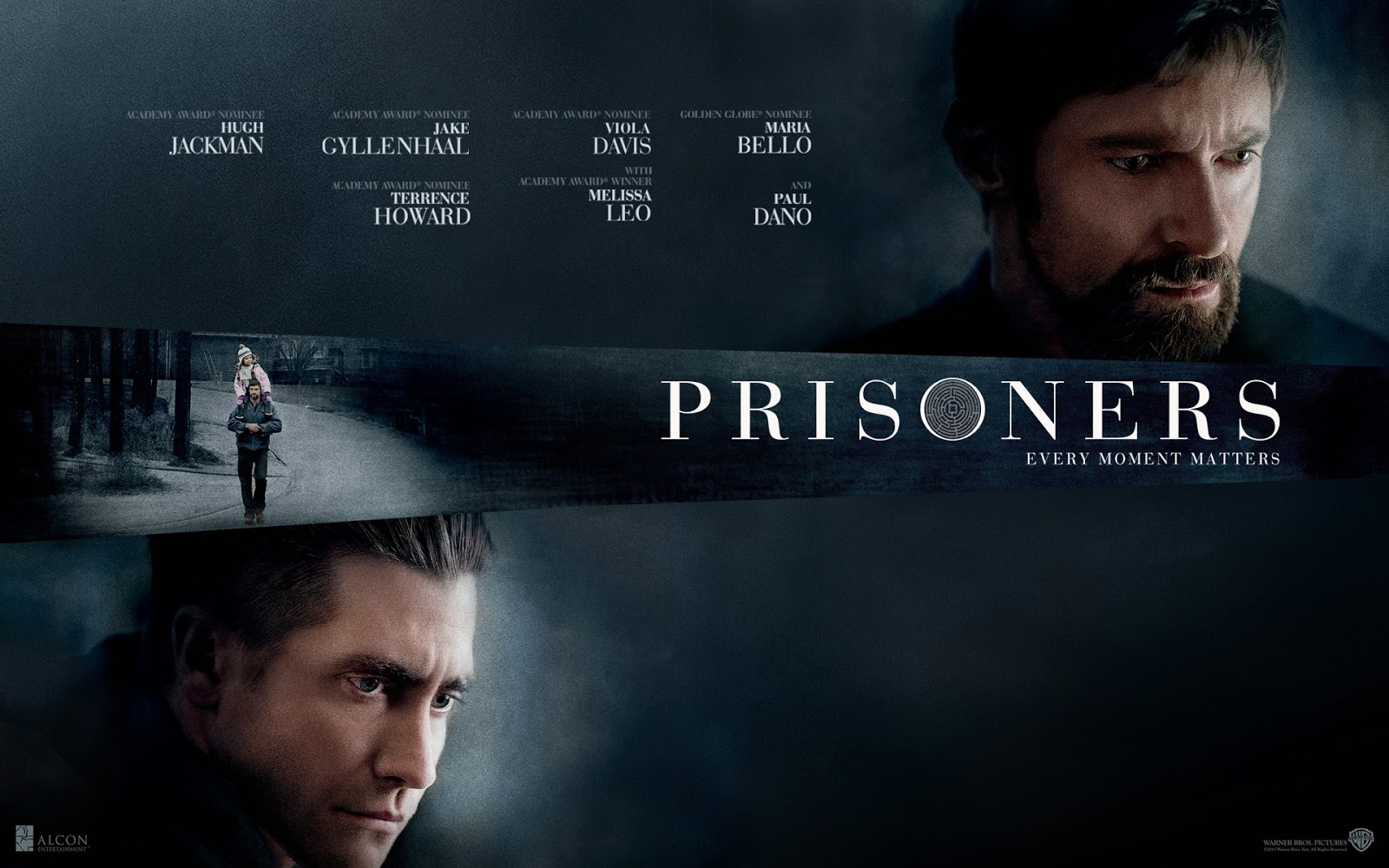
Prisoners (2013)


Fully deserving of mention in the same breath—or gasp—as Seven, Mystic River, and Zodiac, Prisoners' fragmented central mystery burns with white-hot intensity. Director Denis Villeneuve and writer Aaron Guzikowski weave a dense narrative web of seemingly disparate plot strands interwoven around a complex moral core; the movie is concerned with the psychological, emotional and social consequences of violence as much as solving the crime.

The wages of sin, guilt, vengeance and redemption weigh heavily on the characters of Prisoners. With remarkable visual elegance and economy, the gifted Quebecois director flawlessly captures the moods and mores of small-town, God-fearing America. “Our Father, who art in heaven, hallowed be Thy name. Thy kingdom come. Thy will be done, on earth as it is in Heaven.” These words open Villeneuve’s film, spoken over a wintry forest landscape, frozen in the icy late-autumn chill. The slow, creeping camera pulls back to reveal the barrel of a shotgun, pointed head on at a lonely deer. This is only the first of many images of predators pursuing their prey.

Friday, September 27, 2013

Punch-Drunk Love (2002) Analysis


Calling Paul Thomas Anderson’s Punch-Drunk Love a romantic comedy seems inappropriate; although it utilizes many of the conventions of the genre, it does so self-consciously, and subverts more conventions than it embraces, casting a knowing gaze on the lighthearted, predictable, and frequently mindless Hollywood fare and twisting it into this surreal, darkly funny, completely surprising and truly original movie of often fearsome beauty. In traditional romantic comedies, as in P.T. Anderson’s film, boy meets girl and has to overcome substantial obstacles strewn across the path to true love; if only more movies could incorporate the use of crowbars, novelty toilet plungers, hundreds of cups of Healthy Choice pudding, harmonium abandonment, and phone sex extortionists into their love stories, a trip to the multiplex would be ever so much more exciting. From the first scenes of Punch-Drunk Love, it is clear we have left the world as we know it and entered the writer/director’s universe, in which the earth seems to rotate and revolve much as it does in real life, only at a rather skewed angle, and everything stands suspended a few degrees away from logic and reality.