Intro

I love movies. I have loved movies all my life. I grew up on them. When I was eight years old, I managed to convince myself I would make movies when I grew up. Now I am in the process of getting a degree in Film Studies. I write about film more than ever before, partly because I have to for my classes, mostly because I enjoy it, because I have something to write about. Sometimes it helps me understand the film better; sometimes it helps me understand myself better.
I created this blog as a place to showcase my work, and also as an incentive to keep writing reviews, analyses, and essays over breaks, when there’s no one here to grade me.
I have tried many times, and failed, to explain in a coherent manner why it is that I love films. Here is my best—and most coherent—guess.


Showing posts with label Thriller. Show all posts

Thursday, June 26, 2014

The Two Faces of January (2014)


Drive screenwriter Hossein Amini’s directorial debut takes its title from the English derivation of Janus, the two-faced Roman god who stands at the cusp of the new year, simultaneously musing backward at recent lessons and experiences, and peering forward to the murky and elusive future ahead, a guardian at the crossroads of the past and present. The reference implies the twin forces of duplicity and shifting circumstances that swirl in the fragrant atmosphere of The Two Faces of January, an old-school, sly, seductive Southern Europe-set tale of moral compromise and misdirection. Based on the Patricia Highsmith novel of the same name, Amini’s film has its own two faces; it’s at once an involving character drama and a gripping suspense movie, a pleasurable period piece of precision and class and a tight and tidy thriller as shrewd, sleek, and scintillating as its characters.

Sunday, November 10, 2013

Captain Phillips (2013)


Sandwiched in between Gravity and All Is Lost, Paul Greengrass’ Captain Phillips is only one of many, incredibly well-made, gripping but grim survival tales to hit the theaters this fall—a season of soaring cinematic standards as much as of falling leaves.

Impeccably constructed and surprisingly complex, the movie succeeds on all notes but one: characterization. Based on the real-life takeover of an American cargo ship by Somali pirates, it offers an immaculate reconstruction of a chaotic incident, portrayed on screen with immediacy and intelligence. Full of kinetic energy, exciting and suspenseful, the film traces Captain Richard Phillips’ ill-fated journey on and off the Maersk Alabama in early April of 2009. The only problem is we don’t know enough about him, the journey, the ship, or the pirates to care.

“It’s just business,” pirate leader Muse (Barkhad Abdi) keeps repeating, a phrase not actuality uttered, but reflected in the attitude of Captain Phillips (Tom Hanks, portraying the kind of quiet, commanding role Oscar dreams are made of). Curt and professional towards his crew and extremely attentive to security measures, the title character is a civilian tasked with getting a huge cargo ship safely from Oman to Kenya down the Horn of Africa. It’s clear he just wants to get the job done as quickly and effectively as possible.

Friday, November 1, 2013

The Counselor (2013)


The Counselor, Cormac McCarthy’s much-anticipated screen-writing debut paints an elusive, eccentric, exquisitely rendered picture of poetic pain. Filled with bizarre, bone-grinding violence, twisted characters, confusion and moral compromise, Ridley Scott’s movie becomes a sodden, sordid cautionary tale of good and—mostly—evil. If you were looking forward to the crime thriller—more Tony than Ridley—the film’s trailer seems bent on promoting, The Counselor is not it.

Michael Fassbender heads a burning hot all-star cast, all outshined, hover, by the pulpy, lyrical, hardboiled and hell-bound script, a foray into the mesmerizing and merciless milieu of corrosive drug trade on the American-Mexican border—a barrier as moral as it is geographical for much of American fiction. McCarthy and Scott enter a closed, dangerous, elite world, devoid of any ordinary people to act as gateways or guides for the audience or to remind us of a reality beyond the brutal one of the cartel.

Thursday, October 3, 2013

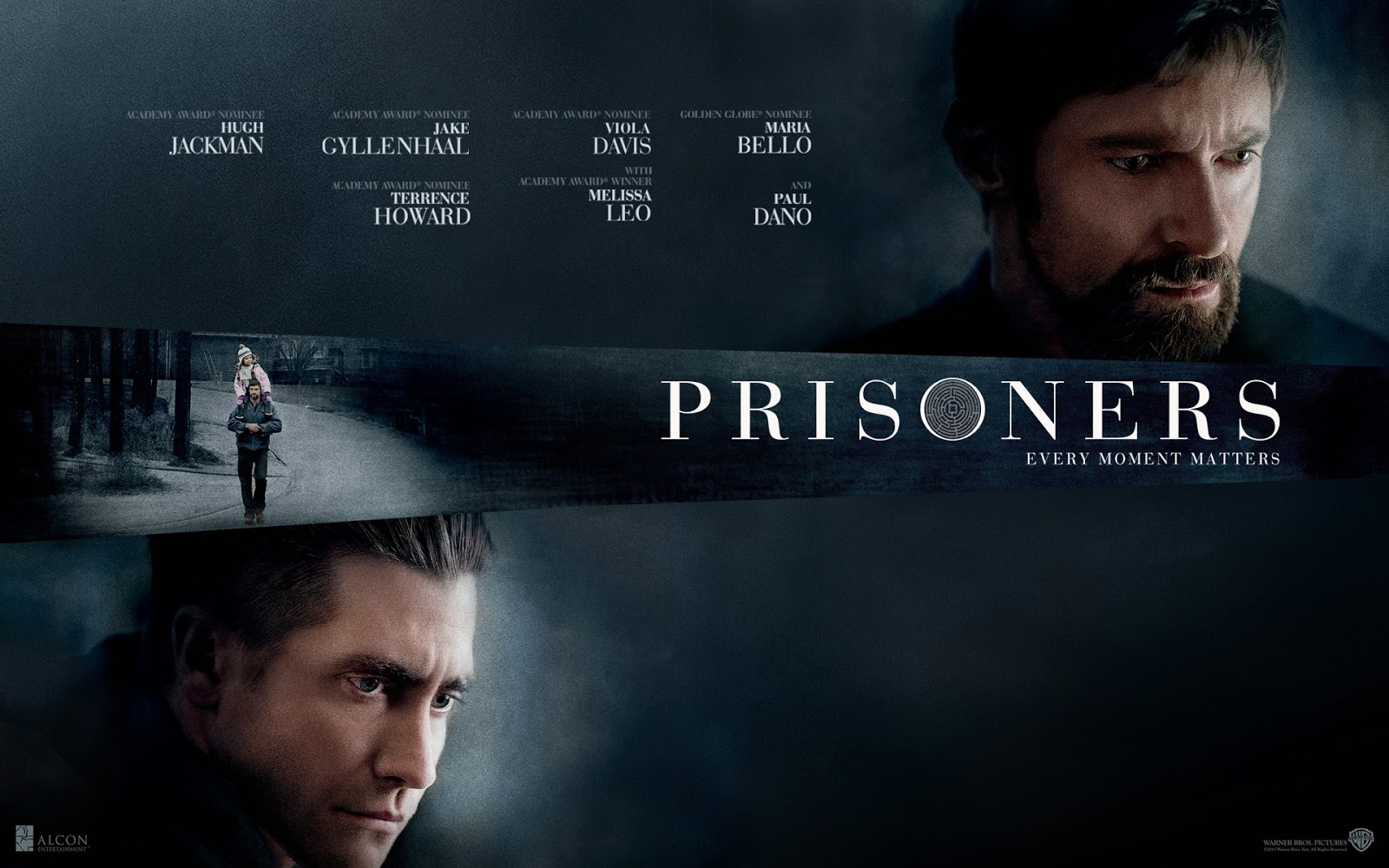
Prisoners (2013)


Fully deserving of mention in the same breath—or gasp—as Seven, Mystic River, and Zodiac, Prisoners' fragmented central mystery burns with white-hot intensity. Director Denis Villeneuve and writer Aaron Guzikowski weave a dense narrative web of seemingly disparate plot strands interwoven around a complex moral core; the movie is concerned with the psychological, emotional and social consequences of violence as much as solving the crime.

The wages of sin, guilt, vengeance and redemption weigh heavily on the characters of Prisoners. With remarkable visual elegance and economy, the gifted Quebecois director flawlessly captures the moods and mores of small-town, God-fearing America. “Our Father, who art in heaven, hallowed be Thy name. Thy kingdom come. Thy will be done, on earth as it is in Heaven.” These words open Villeneuve’s film, spoken over a wintry forest landscape, frozen in the icy late-autumn chill. The slow, creeping camera pulls back to reveal the barrel of a shotgun, pointed head on at a lonely deer. This is only the first of many images of predators pursuing their prey.

Thursday, February 28, 2013

"I Can’t Remember to Forget You": The Nolan Brothers’ “Memento Mori” and Memento


Time is an absurdity. An abstraction. The only thing that matters is this moment. This moment a million times over. You have to trust me. If this moment is repeated enough, if you keep trying—and you have to keep trying—eventually you will come across the next item on your list.                      Jonathan Nolan, “Memento Mori”

Jonathan Nolan’s short story “Memento Mori,” published in Esquire in 2001, and Christopher Nolan’s Memento, released in 2000, blend a black, jagged sense of humor with sobering thematic meditations on time, memory, knowledge, and grief. Focusing on a man suffering from short term memory loss, or anterograde amnesia, they present a character adrift in space, time, and experience, whose life is a waking kaleidoscopic nightmare of conflicting details, an endless repetition of first encounters and first impressions. He describes it as waking up, experiencing the same confusion and disorientation we all do when we get out of bed in the morning, but for him it happens roughly every ten minutes. While “Memento Mori” is all internal, capturing Earl’s setting, thoughts and actions without the introduction of any other characters or dialogue, the movie Memento, an aggressively nonlinear riddle tangled up in a dizzying, elegant spiral structure that moves backwards, forwards, and sideways, sometimes at the same time, takes the basic idea of the story and develops it into a feature length film, expanding and changing it to fit the requirements of the medium while maintaining the same darkly comic tone and general idea and backstory.

***This is a comparative essay and it contains spoilers.