Intro

I love movies. I have loved movies all my life. I grew up on them. When I was eight years old, I managed to convince myself I would make movies when I grew up. Now I am in the process of getting a degree in Film Studies. I write about film more than ever before, partly because I have to for my classes, mostly because I enjoy it, because I have something to write about. Sometimes it helps me understand the film better; sometimes it helps me understand myself better.
I created this blog as a place to showcase my work, and also as an incentive to keep writing reviews, analyses, and essays over breaks, when there’s no one here to grade me.
I have tried many times, and failed, to explain in a coherent manner why it is that I love films. Here is my best—and most coherent—guess.


Showing posts with label Comedy. Show all posts

Saturday, April 18, 2015

"Must Be Exhausting": Nihilism, Irony and Comedy in Coen Neo-Noir


“The Absurd is not in man… nor in the world, but in their presence together. For the moment it is the only bond uniting them.”
–Albert Camus, The Myth of Sisyphus

 “That’s life. Whichever way you turn, fate sticks out a foot to trip you”
–Al Roberts, Detour (Edgar G. Ulmer, 1945)

Bunny Lebowski: Ulli doesn’t care about anything. He’s a nihilist.
The Dude: Ah. Must be exhausting
– The Big Lebowski (Joel and Ethan Coen, 1998)


Joel and Ethan Coen, the double-brained, quadruple-handed creative entity behind some of the most boldly original films to come out of the post-New-Hollywood generation, have created and maintained a unique, unmistakable signature style, a willful blend of darkness, humor, and sophistication. The sixteen movies the brothers have written, directed, and produced to date mostly limit themselves to the confines of two recognizable registers, film noir and comedy. Prior to the darkly comedic unraveling of noir themes, characters, and motifs in such postmodern works as Quentin Tarantino’s Reservoir Dogs (1992) and Pulp Fiction (1994), the Coens were already making (self-)consciously comic use of noir plots and stylistic techniques through their characteristic mix of irony, poetry, and drama. Commentators, noting the pair’s cold, cynical treatment of characters and their fiercely, hyperconsciously intertextual play on films past, have sometimes described the Coens’ work as emptied out stylization or as unnecessarily grim, pessimistic, and even amoral. Using Blood Simple (1984), the filmmakers’ first feature effort, I will argue that far from social, moral, and political apathy, what emerges in the films of the Coen brothers is a consistent, if occasionally nihilistic, philosophy of human experience. The directors’ work manages to repurpose and revitalize conventions of past cultural forms in a way that is meaningful to the present moment. Perhaps even more importantly, their films amount to a deeper investigation of the human condition that is as serious and engaged as it is humorously macabre.

Wednesday, March 25, 2015

High School Confidential


Roger Ebert opens his review of Rian Johnson’s debut feature Brick (2005) with the following quote from Elaine May’s A New Leaf: “You have preserved in your own lifetime, sir, a way of life that was dead before you were born.” The line is more than appropriate, considering Brick is, in a surprisingly straightfaced manner, carrying on in its own lifetime a style of film that was dead long before it was born. At the same time, the depth of feeling and sincerity that runs through the film makes it seem utterly, breathlessly alive. In part nostalgic for a time and a style long passed, in part playing with and updating the conventions of the classic noir, Johnson’s film transposes the snaking plots and sneaky moods of gritty detective fiction to a contemporary high school—90210 goes noir, or what we would imagine a David Lynch or Coen brothers reimagining of Heathers might look like.

The movie, which hums with constant menace and sparks with hipster slang, was awarded the Sundance Film Festival’s Special Jury Prize for Originality of Vision in 2005—and, whether or not you can take its premise seriously, there is no denying it is a work of originality and vision. Brick is an intriguing experiment in determination that unashamedly demands your attention, “one of those movies than seems not made but born—a small masterpiece that’s perfectly strange and strangely perfect” (Patterson). The combination is surprising, but what is even more surprising is the extent to which it works. The question begs to be raised, why is the Hammet-Chandler school so readily compatible with actual school?

Thursday, January 29, 2015

City Lights (1931) Analysis


The Tramp, wearing tails, drives around in a Rolls Royce.  He spots a man smoking a cigar and patiently follows in the car until he drops the butt. The character jumps out of the Rolls, fights off an old, ragged bum who had himself bent over to pick up the cigar butt, grabs it, sticks it into his mouth, leaps back into his Rolls and drives away smoking; the assaulted bum looks on in stunned silence. This little comic bit, one of the countless memorable scenes in Charlie Chaplin’s City Lights (1931) is more than just a funny sight gag; it is a glimpse into a way of life and into the underlying metaphor of many of the filmmaker’s works. The sequence underscores much of what the great artist’s career was built on: the contrast of wealth and poverty, surface riches and actual need, appearance and essence. What the Tramp needed was never financial success—he was destined, from the time of Chaplin’s Essanay shorts, to fail at attaining material rewards. What the character wanted was of a more spiritual nature: love and acceptance into “proper” society. Most of the time, he was doomed to fail at attaining that as well.

Read my analysis of Chaplin's The Circus here.

Saturday, November 29, 2014

Harold Lloyd and the American Dream: How Speedy Turned into Willie Loman—and Back Again


A young man, straight out of high school, with hopes of a dramatic stage career, hangs around the Edison Company studio, watching the actors, stars as well as lowly extras, walk through the gate. Unable to get work in the legitimate theater, he has turned, temporarily he hopes, to films. But access is denied. All of the directors have their favorite extras, and all of the favorite extras have passes to get through the studio gate in the morning. Unknown, with only one day of work in the movie industry on his resume, playing a Yaqui Indian no less, the man waits and hopes. One day, however, he notices that when all the extras return from lunch, in full makeup, no one asks to see their passes. He devises a plan right there and then. Dawdling away his morning, the young man makes himself up lavishly during the noon hour and joins the returning crowd at one o’clock, slipping in, with a casual wave to the gateman, for the afternoon shooting. The year is 1913, the young man Harold Lloyd. The actor was dogged, inventive, self-made, compensating for what he lacked in experience, training or talent with sheer energy, bounce, and push. It hadn’t occurred to him yet that he would someday play himself.

Lloyd’s entry into the studio that day—and therefore the movie industry— reads like a partial scenario for one of his later films. “He can do anything he tries,” the smitten sweetheart says in the first reel of Never Weaken (1921). It is not only her love for Lloyd’s character that engenders this type of unquestioning faith. Harold the character, as well as Harold the actor, could do most anything he set his mind to. In his best thrill comedies, he generated sympathy not only because he was liable to drop to his death at any moment, but also because he simply refused to. In film after film, Lloyd put himself in danger and emerged unscathed; he got the money, got the girl, and, most importantly, got ahead. His trials, tribulations, and ultimate triumphs spelled the facet of the American Dream on which his mass appeal was built: a mediocre individual and how much he can accomplish through the right combination of hard work, luck, and pluck.

A perfect example of his unwavering climb (this time to success and popularity rather than up a skyscraper) presents itself in the narrative of The Freshman (1925), directed by Frank C. Newmeyer and Sam Taylor. A small-town young man with wildly unrealistic dreams of college, Harold Lamb—and what better name could underscore his innocence—seems the least likely person on the planet to become popular, but giving up is a foreign concept to him. By the end, he has everything he ever wanted: his classmates’ respect and adoration and a beautiful girl who loves him. The future has never looked brighter; there is no way this young man will not win in life as he did on that football field, or even, hopefully, taking fewer falls and hits. Twenty years later, in Preston Sturges’ characteristically disenchanted Mad Wednesday (1947), the once hearty  and hopeful Harold, now bearing the purposely bureaucratized last name of Diddlebock, is slow, broken, bent, a sad parody of the dreams he had as a boy, of Lamb’s triumph as well as the falsity of idealistic American clichés that triumph was built on. Lloyd’s silent characters embodied the hopes of the nation in the twenties, but his naïve optimism had no pull on a post-Depression era audience in the sound period. The homely, small-town values had betrayed him as well as the viewers; the tools required for success in this world—significantly, in Sturges’ film an urban one—were of a much more cynical nature.

Friday, August 29, 2014

Through the Looking Glass: Buster Keaton’s "Sherlock Jr."


Over sixty years before Woody Allen had his characters pop off the screen and into the film’s reality in The Purple Rose of Cairo (1985), Buster Keaton had done the reverse. In Sherlock Jr. (1924), the most silent of all silent clowns played a movie projectionist studying to become a detective. Falling asleep in his booth, he dreams himself into the picture, simply walking down the aisle and into the movie-within-a-movie, where he finds he is at the mercy of film space and film time. While he stands still, maintaining his space-time continuity, the “unreal,” cinematic environment surrounding Buster undergoes the editing process. His universe instantaneously shifts from a park to a desert, to an ocean, to a snowdrift, and the character, although maintaining complete control over himself and his actions, is powerless against the filmic montage that changes his physical surroundings.

The scene epitomizes and exaggerates the conditions in which Keaton the filmmaker has placed Buster the character throughout his career. In film after film, he battled immense natural forces and huge mechanical objects which were beyond his control; in film after film, he simply reacted to the environment and the situation as pragmatically as possible, generally in ways that would solve his problems. Again and again, with elegance, poise, and superb command of his body—at once the most malleable and most tensile of physical objects—Buster made impossible physical stunts look not only possible, but effortless. He used no stunt doubles, no tricks, no sleights of camera or editing.

Keaton’s creative ideas as director, his inventiveness and determination, parallel his ideas as a clown. When cinematic wizardry is used, as it is in the montage sequence of Sherlock Jr., it makes Buster’s life harder, not easier. But the sequence is more than just stunting. It is perhaps Keaton’s clearest realization of the cinema’s mechanical basis, his greatest expression of control over the first and ultimate machine of his career—the camera, that unique mechanical object capable of representing and reshaping reality at the same time. Because, as much as Sherlock Jr. pretends to be about something else, it is a film about film. By taking us inside the picture alongside Buster—and constantly telling us we are, indeed, watching illusion unfold—Sherlock Jr. drops its light comedic premise (about a young man’s wish to become a detective and his romantic troubles) and becomes an almost abstract, unwaveringly funny, look at cinema itself.


Friday, August 15, 2014

The Middle of the Road: Alexander Payne’s Journeys


 “I had been sitting on this Nebraska script even when I did Sideways,” writer-director Alexander Payne said in May 2013. “But I didn’t want to go back to a road-trip movie right after that. I was really tired of shooting people in cars. It’s a drag” (qtd. in Alexander). Despite these misgivings, the filmmaker returns, again and again, to road trips. Recurring throughout Payne’s work is the idea of a pivotal physical pilgrimage that doubles as a journey of self-discovery for his typical protagonist, a damaged but basically good person riddled with unease and inner disenchantment.

In About Schmidt (2002), Sideways (2004), The Descendants (2011), and most recently Nebraska (2013), Payne cannot help but place his characters on physical, psychological, and emotional journeys, ones that might not have a clear destination but which will take the protagonists—and the viewers—to completely unexpected places. More often than not, origin and destination merge, and the characters end up where they had started; they return home, whether that is symbolized by an actual location or by family connections or romantic relationships. The writer-director utilizes the dynamics of the road movie not to express the more common theme of a yearning for escape, but instead to emphasize the psychological primacy of belonging, establishing and—significantly—accepting one’s true home.


Sunday, July 6, 2014

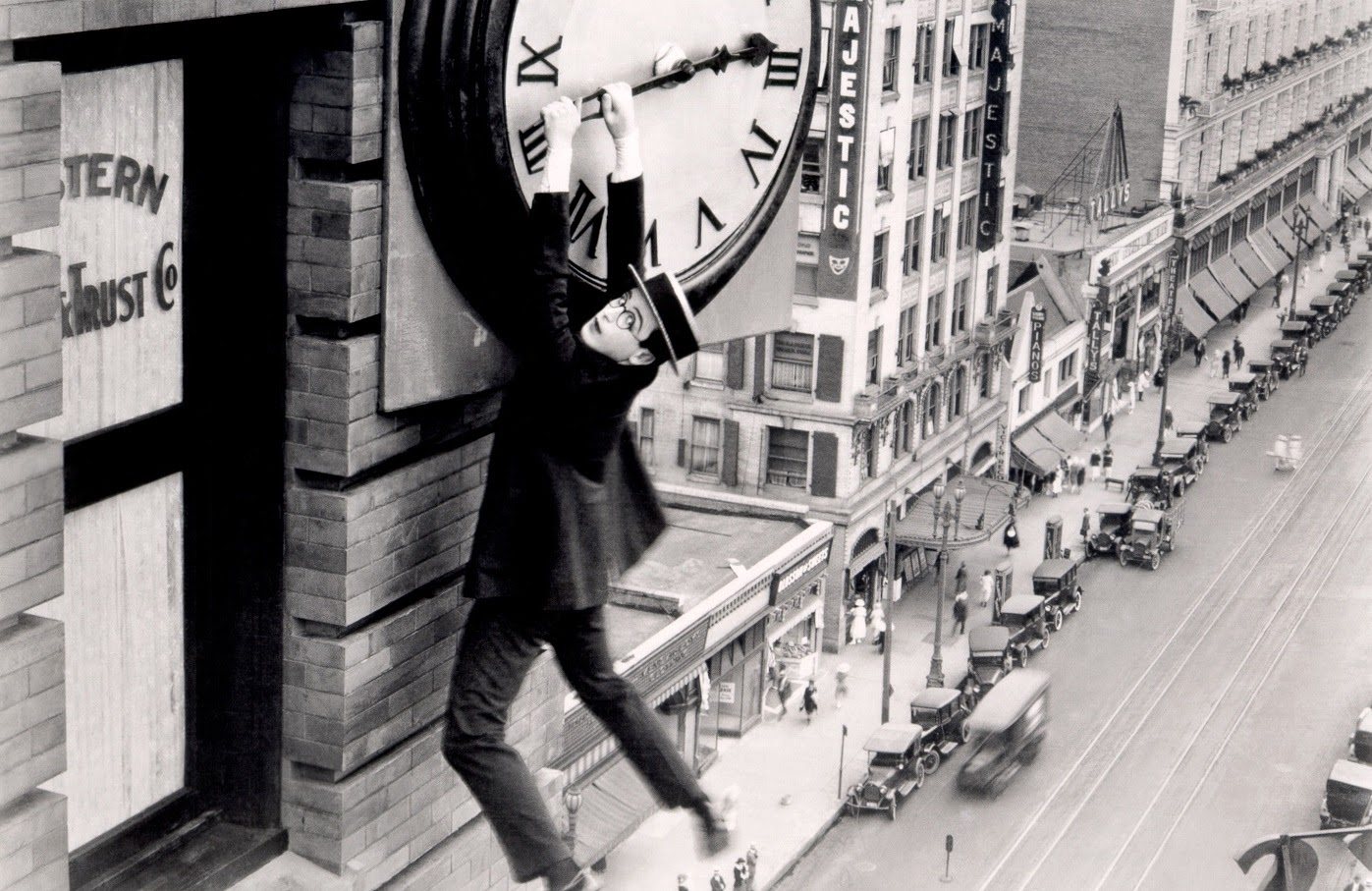
"Safety Last!" and the Most Iconic Image in Silent Comedy


The quintessential Harold Lloyd character is the affable, bespectacled boy next door, anxious to get ahead, not very good at anything, but willing to compensate through sheer energy, bounce, and push; he is the comedic embodiment of the American Dream—what an ordinary man can achieve through a lot of hard work. The filmmaker’s success, as well as that of his characters, is that rare American miracle, the improbable, inspiring accomplishment that couldn’t possibly happen, but did. Safety Last! (1923), Lloyd’s most famous film, tells the story of a small-town young man on the make in the big city, trying to save up enough money so he can marry the woman he loves. Why a story of material betterment and romance should culminate on top of a skyscraper, only Lloyd could tell you. But it is in that juxtaposition of gag and thrill, at the intersection of improbability and idealism, that Lloyd’s specific brand of movie magic transpired. Benefitting from careful plotting, an impeccable sense of timing and tight, functional, unobtrusive editing rhythms, certain sequences of Safety Last!, which follow’s Roach method of accumulation ratherthan Sennett’s madcap speed, can serve as perfect models of how to construct a gag, develop it, twist it, scramble it, then redevelop it, twist it again, and top it. 


Sunday, June 29, 2014

22 Jump Street (2014)


Trying to write a review of 22 Jump Street—which I’ve been putting off for as long as humanly possible—I find myself at a loss. Not because I don’t have anything to say about this sly, self-referencing movie, but because there doesn’t seem to be any need for it. The film is critic-proof, reviewing itself as it goes along. It’s a buddy cop movie about the conventions of buddy cop movies, a sequel about the appeal and downside of sequels, a low expectation summer blockbuster about the low expectations of all summer blockbusters. Basically, it wants to eat its genre parody cake and have it too.

In the first movie, the 2012 hit that borrowed its title and undercover brother shtick from the old television show best known for making every ’80s teenage girl in America and beyond fall in love with Johnny Depp, the Jump Street operation was restarted, Chief Hardy (Nick Offerman) explains, because “The guys in charge of this stuff lack creativity and are completely out of ideas.” That may have registered as a jab at the studio powers that be, but in reality it’s a smiling affirmation that the guys in charge know precisely what they’re doing.

Saturday, March 15, 2014

Harry Langdon: The Elderly Baby


If Laurel and Hardy were grown men who acted like children, Harry Langdon, the most helpless, immature, sexless, timid and downright stupid of all the silent clowns, regressed even further, becoming, in effect, a middle-aged baby, seemingly retaining, by some dogged self-abstraction, the obliviousness and immunity of an embryo to the outside world. His most characteristic gestures and roles, among them the main characters of Frank Capra’s Tramp, Tramp, Tramp and The Strong Man, both released in 1926, combined the masculine and the feminine, the adult and the child. Langdon’s innocence and pathos infuse every frame of film, heightened by complete intellectual blankness to most of what surrounds him. A master of the slow burn, every action and reaction he ever emitted on screen betrays a truly infantile perplexity.

Even his makeup created a strange mixture of discordant opposites—the white powder and dark, heavily outlined eyes—that turned him into a combination of clown, infant, and hermaphrodite. Layered over an obviously adult face, the childlike getup resulted in what James Agee called the look of “an elderly baby” or “a baby dope fiend.” His outfit, made up of round, battered soft hat turned up at the brim, tight jacket with the top button fastened, the others unbuttoned, spreading open ridiculously at the hips, baggy trousers and awkward, oversized shoes, only heightenaed the childish absurdity and inadequacy of his characters, who were completely unfit for the world of men—and especially of women—and incompetent at adult social behavior.

Saturday, February 15, 2014

Thelma and Louise (1991) Opening Clip Analysis


The opening of any film is rife with visual and thematic information and clues that anticipate and inform the rest of the movie. With Thelma & Louise (1991), director Ridley Scott puts a new and gendered spin on both the expansive road movie and the intimate buddy film. Teeming with thrilling, life-affirming energy, exuberant comedy, warmth, and wit, the movie focuses on the two title characters, utterly ordinary, working-class women fleeing the monotony of their lives and discovering unexpected, untapped wells of feeling and strength. Not unlike the Western hero of Hollywood classics, these ordinary women encounter situations and conditions that make them extraordinary. The Western is also invoked through Hans Zimmer’s mournful, tough, galvanizing country tinged score. Even before the first scene, over the opening credits, the music creates a poignant mood that is at once earthly and ethereal, like Thelma & Louise itself—or should it be “themselves”?

Sunday, January 19, 2014

Her (2013)


The movie’s official poster calls Her “A Spike Jonze Love Story.” The decidedly unofficial “honest” movie poster created by Uproxx calls it “a two-hour closeup of Joaquin Phoenix’s face.” More on that in a bit; for now I’d like to focus on the official tagline. Jonze (of the genre-bending—and genre-shaping—Being John Malkovich and Adaptation) is a filmmaker with an astute sense of the absurd. His films are genuinely provocative, brazenly original and bravely inquisitive, and Her, Jonze’s screenwriting debut, is no exception. But the film also offers one of the loveliest romances ever to have graced the silver screen. The fact that it transpires between a man and his software only increases my admiration for the delicacy and depth of feeling packed into the relationship, a brilliant conceptual gag that proves nonetheless sincere and completely plausible. Wildly inventive, challenging and engaging, this subtly profound film follows its own quirky, amusing course. It’s a melancholy, eerie love story unlike anything else you’ve seen this year—or ever.

In Her’s opening shots, Theodore Twombly (Joaquin Phoenix in a quietly heroic, beautifully hushed performance), is making an unabashed declaration of love to an unseen beloved. The actor, as well as his character, is unaffected, sincere, disarming. We quickly discover, however, that his lovely words are not addressed to his beloved at all, that this is what Theodore does for a living; the character is a latter-day Cyrano writing heartfelt notes-for-hire at BeautifulHandwrittenLetters.com (the handwriting all computer-generated, of course). The cuteness is instantly turned to cynicism, in a movie that is both visionary and traditional, tender and cool, passionate and wispy. Like the lingering analog affection for handwriting in a digital age, Her argues for both the past and the future, with a soulfully poetic spirit that’s become extremely rare in American cinema.

Tuesday, January 14, 2014

Saving Mr. Banks (2013)


Richly rendered, intoxicating and ingenious, Saving Mr. Banks is at times no less fantastical than stories about governesses who can fly. Director John Lee Hancock of The Blind Side fame, writers Kelly Marcel and Sue Smith, and the superb ensemble of seasoned actors create a riveting backstage account of artistic collaboration, a clash of Hollywood titans marbled with moments of high comedy. The Walt-worthy giddiness, depth of feeling, and the stunning performances elevate the story above its premise as an unapologetically retro valentine to the studio that is the most literal Hollywood dream factory.

Thick with affection and old-fashioned showmanship, the movie is a Disney fairytale based on fact, namely the making of Mary Poppins, the much beloved 1964 musical fantasy that put Walt and his boys on the map as serious creators of live action family entertainment. There are knowing winks to Disney’s flying nanny, but Saving Mr. Banks is accessible and enjoyable to even those entirely innocent to the original film—if such people exist.

Thursday, December 26, 2013

The Circus (1928) Analysis


Those who think that Charlie Chaplin’s use of simple, mostly passive camerawork and compositions stemmed from poor craftsmanship ought to think a bit more about the hall of mirrors scene in the filmmaker’s The Circus (1928).  Chaplin’s technique was meant to find precisely the right angle to communicate the pictorial, intellectual, and emotional values of the shot, foregrounding character, acting, theme, and story over cinematic elements. His chaste, even static camera was confined largely to patient waiting while he reached through it to make contact with us, but if Chaplin wanted to be flashy, Chaplin could be flashy. Almost a full two decades before the similar celebrated sequence of Orson Welles’ The Lady from Shanghai (1946), Chaplin had mastered the cinematic technique necessary to shoot an infinite series of reflections at once.

In The Circus scene, the Tramp finds himself dodging both a policeman and a pickpocket when he runs into the hall of mirrors. Chaplin choreographs the cross-eyed images in the hall so precisely that the two men, running away from each other, bump headlong. The main character’s own figure is multiplied a hundred times so that it is impossible to distinguish the reflection from the man. The sequence serves, however, a thematic purpose much more important than the visual magic it creates. Chaplin, through the numerous reflections and repetitions of his own character, communicates a fractured sense of self, an incomplete identity. Caught between legitimate society (represented by the cop) and a wayward life of crime (represented by the pickpocket), Charlie must choose his own persona; he must discover, as he will throughout the movie, who and what he is and how that relates to all the other facets of himself (the reflections): who and what he appears to be to others, who he wants to be, and who he will never be.

Saturday, November 23, 2013

Sennett and Roach: Two Methods to the Madness

“The Mack Sennett Keystone comedies were the culmination of 15 years of comic primitivism—the characterless jest and the excitement of motion raised to the nth power” (Mast 43). Before Sennett, American film comedy had been confined to the music hall sketch; he gave it the freedom of destructive absurdity. While still at Biograph, the future King of Comedy moved Griffith’s static, inert, indoor-bound camera outside, where it enjoyed both visual freedom and the freedom to move. And move it did, at mad speed, nearing supersonic velocity, stopping only when the figures onscreen smashed through one wall too many, fell down manholes or wells too deep, or were simply overcome with exhaustion The filmmaker added tremendous energy and breathtaking pace, the incongruous and the non sequitur, and a taste for burlesquing people, social custom, and the conventions of other films.

Hal Roach was always second to Sennett; the latter established the formula while the former merely adopted it. While Roach began imitatively, copying Sennett’s chases, falls, custard-pie throwing, and generalized chaos, he gradually began thinking more in terms of character than non sequitur, carefully structured gags instead of speed, logical plotting rather than constant, cumulative romping. Roach’s films benefited from more structure, less improvisation, creating what Gerald Mast calls a perfect stairway to insanity (185). To use the same metaphor, Sennett did not ever take the stairs up; he took the elevator, punched the floor button—or, if feeling especially inventive, whacked it with a hammer—got stuck a couple of times between levels, sometimes plummeted, coming close to the bottom of the elevator shaft, and, finally, shot through the roof.

Monday, October 7, 2013

Tillie's Punctured Romance (1914) Analysis


Tillie’s Punctured Romance, released in 1914, marks Mack Sennett’s first feature length film and his biggest Keystone project. Bringing together all the talent on the Sennett lot—and then some—the movie is also notable as Marie Dressler’s first screen appearance. An adaptation of the stage success “Tillie’s Nightmare,” which also starred Dressler, the film tells a conventional tale of a simple country gal (Dressler) who gets swindled by a shark  from the big city (played by Charlie Chaplin). “The fetid atmosphere of the wicked city” and the country’s “pure breath of open spaces” are placed in sharp and comedic opposition, while the straight-forward, uncomplicated plot—essentially the material of any one of the director’s shorts stretched out for over an hour—becomes simply a pretext for a series of gags, mounting in rhythm and intensity to a speedy culmination; Sennett, parodying both the melodramas of the time (shades of Griffith’s Way Down East) and a gaggle of intellectual pretensions, lofty sentiments and noble virtues, demonstrates once again that tense melodrama and comedic farce are not that far apart; all it takes is an alteration or exaggeration of character personalities, a scrambling of editing rhythms, and a distortion of events, and seriousness dissolves into laughter.

Sunday, September 22, 2013

Annie Hall (1977) Analysis


Woody Allen’s Annie Hall captures the full development of the director’s carefully constructed persona. Like Chaplin’s Tramp, Woody is also the eternal underdog; his story is undeniably funny, but also poignantly sad. Under the comedy lies a barely concealed truth, a healthy amount of the tragic. Over the years, Allen has become predictable, but that’s not necessarily a bad thing. He has us laughing before we ever hear the punchline, because we know exactly what it’s going to be. Allen, like Chaplin, draws on his own life for inspiration, and always puts feeling into his movies, whether they are dramas or the usual romantic comedy. Alvy Singer is self-consciously a New Yorker, an egocentric intellectual, and an overly anxious, death-fearing paranoid comedian made in the director’s own image.

The film starts and ends with jokes, but we’re decidedly less likely to laugh by the end, because we recognize the truth behind the punchline. Alvy warns us in the beginning that life is “full of loneliness and misery and suffering and it’s all over way too quickly.” He also spells out his belief on relationships: he’d “never want to belong to any club that would have [him] as a member.” About an hour and a half later, he concludes that relationships are “totally irrational and crazy and absurd, but we need the eggs.” What Alvy wants is something unattainable, and he’s an expert at making it unattainable. 

Monday, August 26, 2013

Kick-Ass 2 (2013)


Crude, crass, callous and filled with carnage, Kick-Ass 2 commands our attention. Half smart-allecky satire, half semi-plausible vigilante fantasy, the movie is a worthy, if inferior, successor to Matthew Vaughn’s original. The series’ first director and co-writer remains on board as producer, but the creative reins have been handed down to the little-known Jeff Wadlow.

2010’s Kick-Ass, a brilliant, brazen, charcoal black action-comedy about a shy, nerdy teen trying to make it as a crime fighter was a breath of fresh air, the anti-Spiderman young superhero adventure I’d been waiting for. This screwy, savvy, self-conscious and self-satisfied sequel fills the screen with even more arterial spray and lays the irony on even thicker. By the second outing, however, it’s getting harder to distinguish Kick-Ass from the polished, name-brand superhero flicks it seemed to offer us respite from.

While still bone-crushingly brutal, Kick-Ass 2 drops its punchy predecessor’s attempt to pass the visceral, vicious violence off as something shocking or subversive. Gory, gimmicky, and grisly, the first film was deliciously and insolently provocative; it introduced crime-fighting children who toted guns, shot to kill, and cursed like Samuel L. Jackson. A joke is rarely as funny the second time you hear it, but Kick-Ass 2 offers a fresh infusion of comic energy in the loose, flippant approach to its source material, the ongoing Marvel series by Mark Millar and John S. Romita Jr.

Sunday, August 18, 2013

This Is the End (2013)


For most people, the apocalypse and eternal damnation are topics of sober reflection and deep despair. Seth Rogen is not most people. A graduate of the popular, profitable Judd Appatow comic fraternity, Rogen and co-writer/director Evan Goldberg create a perfect mix of hilarity and horror, goofiness and gore in the funny-as-hell This Is the End.

Based on the 2007 never-released short Seth and Jay vs. the Apocalypse, the movie is surprising, suspenseful, outrageous, absurd, and ultimately jubilant; it lets off an infectious sense of fun and the spiky comic energy of a foul-mouthed but generally good-natured hard R-rated comedy of near-cataclysmic levels of vulgarity and excess.

Saturday, July 13, 2013

The Lone Ranger (2013)


Gore Verbinski’s reboot of the Depression era radio and baby boom television Western hero enters a world of tall tales and strange myths. The Lone Ranger delivers all the energy moviegoers have come to expect from a hectic Jerry Bruckheimer super-mega production, and only mild bouts of mindlessness cheapen this imaginative and bold film.

Extravagant, excessive, and intermittently exhausting, the vaguely revisionist, reinvigorated origin story stars the handsome but bland Armie Hammer of The Social Network as the titular masked hero, proving, as Orlando Bloom did in Verbinski’s Pirates of the Caribbean that the main character can be the least compelling personality onscreen; in many ways, the director just took that hugely successful franchise and put it in a saddle.

An almost unrecognizable Johnny Depp—at least until he opens his mouth or makes the sort of flamboyant gesture any Captain Jack Sparrow fan knows and loves—gets top billing as Hollywood’s most iconic Injun. An outcast isolated from both his tribe and the white world, Tonto has his own reasons for riding alongside the masked avenger. He is no longer just a sidekick, but a mentor and the reason the movie works to the extent that it does. Heavily face-painted and sporting a dead-crow tiara he sometimes tries to feed—maybe someone should have told him that bird in Kirby Sattler’s paining “I Am Crow” was just flying in the background—Depp, like the film, mixes gravity and goofiness.